| Author |
 Topic Topic  |
|
|
danigomel

1 Posts |
 Posted - 08/17/2026 : 20:27:23 Posted - 08/17/2026 : 20:27:23


|
Hi everyone,
I've been using a GMC-600+ to monitor background radiation at home, and I noticed that the CPM changes more than I expected even though the detector stays in exactly the same position.
I left the unit on a desk for 24 hours without moving it. During the test, the readings were generally between 28 and 42 CPM, with an average of around 34 CPM. Most of the time the changes were gradual, but I also recorded several short peaks above 50 CPM. The highest value I saw was 57 CPM.
There was no radioactive source nearby and I didn't change the USB connection or the measurement settings during the test. The room temperature was roughly 24–26 °C.
For those who regularly monitor background levels with a GMC-600+, how much variation do you normally see over a 12–24 hour period? Is a range such as 28–57 CPM considered normal background fluctuation for this type of detector, or should I be looking at the average over a longer period before judging the stability?
I'd be interested to compare results from other GMC-600+ users. |
https://amongusonline.io |
|
| Reply #1
ullix

Germany
1257 Posts |
Posted - 08/18/2026 : 01:18:54
|
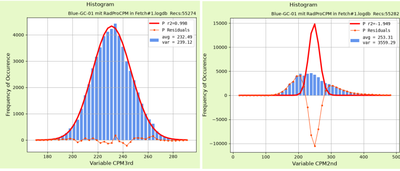
Fluctuation in radioactive decay count rates is a normal process, however, only within very clear limits:
In all GMC counters this may be exaggerated through inappropriate programming of the firmware! Fortunately, you can switch this off by setting FET=60 via the counter's menu!
The fluctuation which you then see is likely the "correct" one; it should follow a Poisson distribution of counts.
A software to easily test this is my GeigerLog, download here (free, is Open Source): https://sourceforge.net/projects/geigerlog/
A very brief explanation of what this is can be found in chapter Poiss – Histogram with Poisson Fit in the GeigerLog manual:
https://sourceforge.net/projects/geigerlog/files/
Here an example: Left side: Good -- right side: Bad
 |
 |
|
| |
Topic |
|
|
|



 GMC-600+ background CPM changes during a 24-hour m
